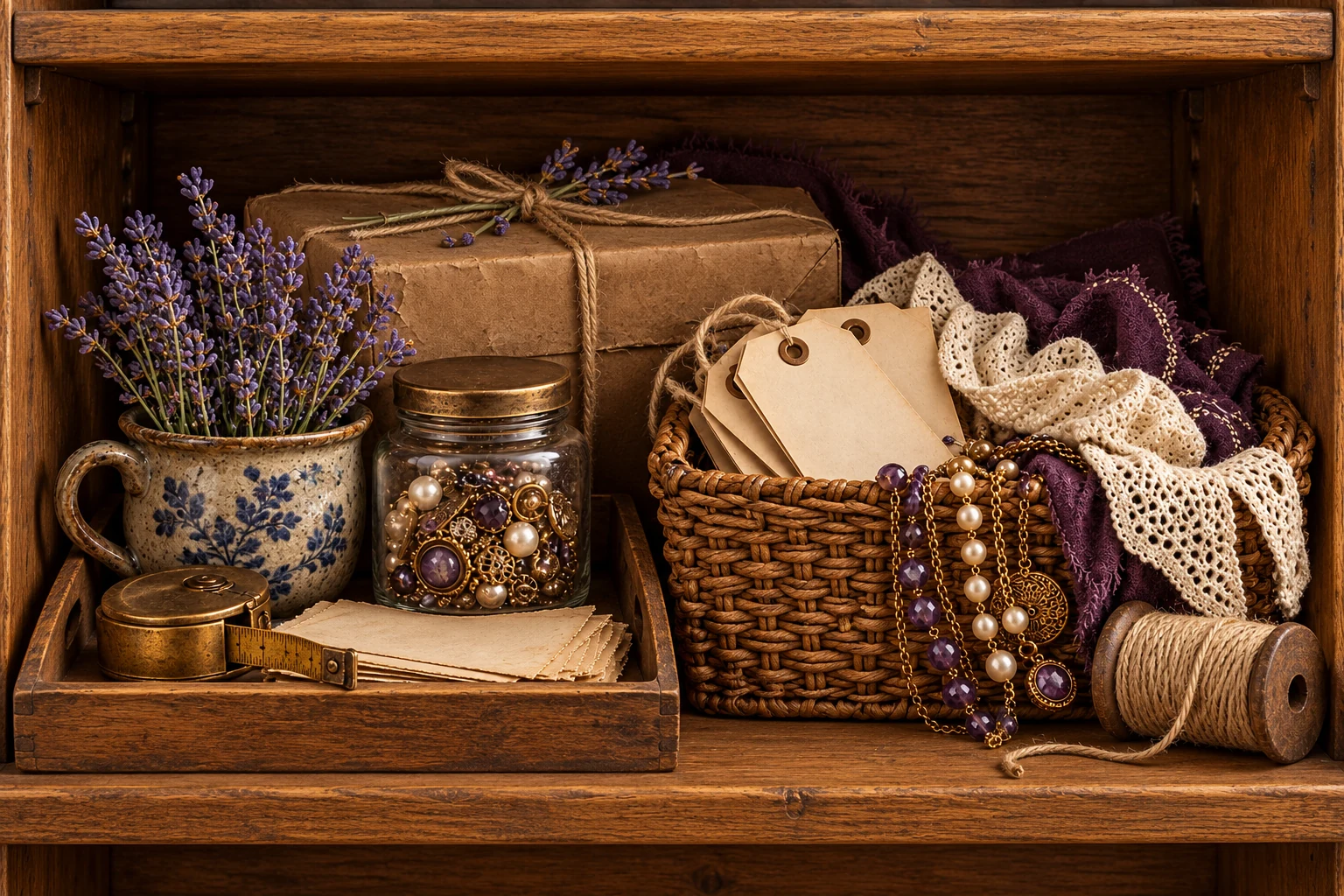
A SKU is simply a short identifier for an item you sell. It gives you something dependable to search for when a buyer sends a question, an item sells, or you need to match a photograph to a listing. It does not have to describe the item’s color, material, year, price, and exact position in the universe.
If your current inventory lives in three totes, a basket, several small boxes, and a suspicious pile beside your desk, start with a system you can use on an ordinary busy day. The best system is the one that still works when you are tired and there are ten more things waiting to be photographed.
Start with one item number and one storage location
Keep two pieces of information separate: the identity of the item and the place where it is stored. An item number answers “Which necklace is this?” A storage location answers “Where did I put it?” Those questions are related, but they are not interchangeable.
For example, a necklace might have the item number ITEM0042 and live in BIN005. If you move it into a different drawer, the item number stays ITEM0042. Only its storage location changes. That small separation prevents a lot of unnecessary renaming later.
A note from the Cabinet
Several items can share a storage bin. Give each one its own item identifier, even when every marketplace listing points to the same bin.
Name the spaces you already have
You do not need to buy a wall of matching containers before you begin. Label the storage you actually use: the plastic tote, the shallow jewelry drawer, the shoebox holding brooches, and the shelf reserved for larger pieces.
- Choose a short naming pattern, such as BIN001, BIN002, and BIN003.
- Put a readable label on the outside of each container.
- Record the location alongside each item in your inventory record.
- Reserve a separate, clearly named place for items still being worked on.
If you sell several types of items, a simple prefix can help: JEW001 for a jewelry drawer or SHELF01 for a shelf. Use prefixes only when they help you find something. A system with twelve different naming rules is another task to remember.
Make the identifier boring on purpose
It is tempting to create codes that tell an entire story: sterling silver, green stone, purchased in September, third drawer, second row. The problem is that stories change. An item may be moved, a material identification may be corrected, or a drawer may be reorganized.
A plain sequence is easier to maintain. Pick a number length that leaves room to grow and keep leading zeroes consistent. ITEM0042 and ITEM042 may look equivalent to a person, but mixed formatting can make searching, sorting, and importing unnecessarily awkward.
Your inventory system should help you find the thing, not become another thing you have to find time to manage.
Put the same information in the places you actually look
For every active item, keep its identifier and storage location in your inventory record. Add the relevant identifier to the marketplace’s SKU field where available. Use a physical tag or a small labeled bag when it makes sense for the item.
A tag does not need to be beautiful. It needs to stay with the item and be readable. Keep it away from surfaces that could be scratched, stained, or damaged, and avoid attaching adhesive labels directly to delicate vintage pieces.
| Item | Identifier | Stored in |
|---|---|---|
| Green stone necklace | ITEM0042 | BIN005 |
| Silver floral brooch | ITEM0043 | BIN005 |
| Boxed ceramic vase | ITEM0044 | SHELF01 |
Notice that the necklace and brooch have different identifiers but share a bin. You can search for either item individually and still pull out the same container when it is time to ship.
Give unfinished items somewhere to wait
Not everything is ready for the stock room. Some pieces need cleaning. Others need measurements, research, a small repair, or one better photograph. If those items are mixed with ready-to-ship inventory, your storage system starts making promises it cannot keep.
Use a few temporary locations that match your work: TO PHOTO, TO RESEARCH, or TO REPAIR. Keep these names visible on the actual trays or baskets. Record the temporary location just as you would record a finished item’s bin.
When an item moves, update the record before moving on to another task. It is a small habit, but it is much easier than trying to reconstruct where something went a week later.
Try this with one basket
Choose ten items that are already listed. Give them consistent identifiers, record their current storage location, and check that you can find each one from its record. That is enough to test the system before you reorganize everything.
Check the system at the moment an item sells
A sale is a useful reality check. Search the record, go to the recorded location, and confirm the item against the listing photographs before packing it. If the item is somewhere else, correct the location immediately instead of leaving the mismatch for later.
Once it has shipped, mark the item as sold in your records. You can reuse the empty storage space, but avoid assigning the old item identifier to a new object. Keeping identifiers unique makes past sales, returns, and questions easier to trace.
You can improve the system without starting over
You may eventually add more drawers, move larger items to a shelf, or separate active inventory from things waiting for research. That is normal. Update the storage locations as your cabinet changes; your item identifiers can stay put.
You do not have to label everything today. Start with one group of active listings, make the names consistent, and use the system for a few sales. Then expand it. A small, dependable system is more useful than an elaborate plan that never reaches the actual boxes.
The aim is simple: when something sells, you know what it is and where it lives. The rest of your cabinet can keep its personality.